
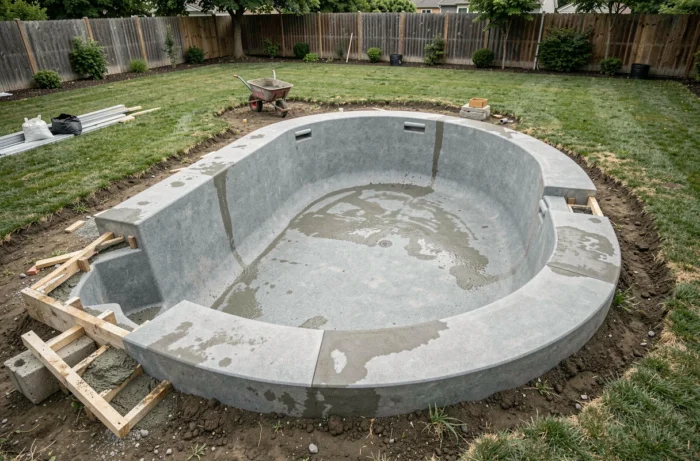
On a pool shell construction site, the problem often arises when installing the coping: the lip of the basin moves, the level is not uniform, and the backfill is already starting to settle. The concrete collar is precisely what prevents this scenario. It locks the upper part of the basin, stabilizes the lip of the polyester shell, and provides a rigid support for the coping.
Without it, the finishes do not last over time.
You can find advice for the concrete collar for pool shells everywhere, but the detail that makes the difference often plays out on-site, between the type of soil, the rebar method, and the timing of the pouring in relation to the backfilling.
Clay Soil and Drainage: What the Concrete Collar Cannot Compensate For
Many homeowners think that a well-dosed concrete collar is enough to protect their pool shell from ground movements. In clay areas, this is false. The shrink-swell of clays exerts lateral pressures that the collar alone cannot absorb.
The requirements of DTU 20.1 (Annex C) remind us of the necessity of a peripheral drain connected to a functional outlet. Without this drainage, water stagnates around the backfill, the soil swells in winter and shrinks in summer. The collar eventually cracks, and the shell can deform at the lip.
Even before thinking about the formwork, it is in one’s best interest to check the nature of the soil. In areas classified as having a medium or high risk of shrink-swell of clays, a G2 soil study is strongly recommended. It allows for the correct sizing of the foundations, including the collar, and anticipates any potential reinforcement by piles or a widened slab.

Reinforcement of the Pool Shell Concrete Collar: Drilling the Lip or the Box
The reinforcement is the part that generates the most questions, and that’s normal. Two methods coexist on-site, with variations depending on the shell manufacturers.
Method by Drilling Only the Lip
The upper lip of the shell is drilled to pass an 8mm rebar, connected to a pin. It’s quick, and poses little risk to the structure. The problem: the shell-collar connection relies on a few millimeters of lip thickness. On a standard polyester shell, this thickness is low, and the mechanical solidarity remains limited.
Method by Drilling Lip and Box
Both the lip and the rigid box underneath are drilled through, interspersing a three-strand rebar, one of which gets wedged between the shell and the first 8mm rebar. The concrete collar then becomes mechanically bonded to the basin, not simply placed on top.
This second method requires more precision. It is necessary to identify the exact thickness of the box to avoid drilling into the shell itself. Feedback on this point varies according to shell brands, and some dealers advise against it out of caution. On a long basin, it offers better resistance to tensile forces.
- Space the drillings evenly around the entire perimeter of the basin, including in the corners where the stresses are greater.
- Use a drill bit suitable for polyester to avoid material splintering, and work at a slow speed.
- Ensure that each rebar passes through the box without reaching the inner wall of the shell by measuring the thickness beforehand.
Formwork and Pouring: Common Mistakes on Site
The formwork for the concrete collar must precisely follow the contour of the pool shell, including in the curves and at the stairs. Typically, formwork boards are used, held in place by clamps or props, with a polyane sheet between the formwork and the shell to prevent the concrete from adhering directly to the polyester.
The pouring is done after partial backfilling and filling the basin with water. This point is often overlooked. If the collar is poured on an empty basin, the pressure of the fresh concrete can deform the shell. Filling the basin beforehand creates an internal counter-pressure that stabilizes the walls during pouring.
The concrete must be sufficiently dosed to ensure structural integrity, without excess mixing water that would weaken the setting. Concrete that is too liquid flows easily into the formwork but loses mechanical strength once dry. A firm concrete is preferred, manually vibrated to eliminate air bubbles without displacing the rebar.
Managing Angles and Sealing Components
The corners of the basin concentrate mechanical stresses. The reinforcement is strengthened there by crossed rebar returns. At the sealing components (skimmer, returns, lights), reservations are left in the formwork. Concrete should not be poured around these elements without protection, or else access for maintenance will be blocked.
Separation Joint Between Concrete Collar and Pool Deck
The concrete collar and the deck slab should not form a monolithic block. If both structures are poured together or without a joint, any differential movement between the deck’s base and the basin causes cracks, or even detachment of the coping.
A flexible separation joint separates the collar from the rest of the terrace. This joint, made of expanded polystyrene or compressible foam, absorbs seasonal micro-movements. It is placed before pouring the deck slab, directly against the outer face of the collar.
- Joint thickness is generally between a few millimeters, adapted to the sizing of the structure.
- The joint runs continuously around the entire perimeter of the collar, without interruption.
- In the case of a raised terrace, provide an independent support (blocks, beams) rather than a direct support on the collar.
This detail may seem minor, but it is one of the primary causes of issues on pool shell terraces. When the terrace pushes against the collar, the stress is transferred to the lip of the basin, with a risk of micro-cracks in the gelcoat.
The concrete collar remains a technical structure whose success depends as much on the preparation of the soil as on the care taken with the reinforcement and formwork. On stable ground, it can be completed in a day. On clay or sloped soil, it is better to invest in a soil study and drainage before pouring anything.