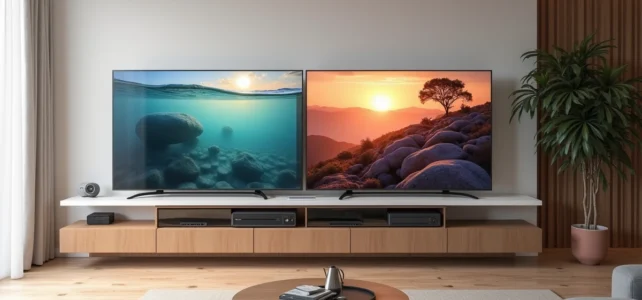
ULED and QLED refer to two distinct approaches to image enhancement on LCD panels. One is a proprietary label encompassing several software and hardware optimizations, while the other relies on a specific physical component (quantum dots). Comparing these two acronyms is akin to measuring a set of treatments against a panel technology. This article details what each acronym truly covers and then analyzes the concrete differences based on the criteria that matter in daily use.
ULED and QLED face to face: comparative table of characteristics
Before diving into the details, a visual summary helps to lay the groundwork. The table below contrasts the two terms based on their technical fundamentals.
Read also : The latest trends and news not to miss for young people in 2024
| Criterion | ULED (Hisense) | QLED (Samsung, TCL, etc.) |
|---|---|---|
| Nature | Commercial label encompassing several optimizations (backlighting, contrast processing, colors, smoothness) | LCD panel technology incorporating a layer of quantum dots |
| Main manufacturer | Hisense | Samsung (creator of the term), adopted by TCL and others |
| Range uniformity | Variable: two ULED TVs may feature very different components depending on the range level | More uniform: the presence of quantum dots is a common denominator |
| Color volume | Depends on the model, sometimes expanded by quantum dots in high-end ranges | Expanded color volume thanks to quantum dots across the entire range |
| Brightness | Variable depending on the type of backlighting (direct, edge, Mini LED on some models) | Generally high, enhanced on Neo QLED models (Mini LED) |
| Contrast | Improved by software processing and backlighting zones | Improved by backlighting zones, significantly superior in Neo QLED |
To delve deeper into the difference between uled and qled on specific models, a detailed comparison allows for confronting the actual technical specifications.
Recommended read : How to Successfully Calculate the Distance and Slope Percentage of a Ramp
ULED: a label, not a panel technology
The most commonly misunderstood point concerns the very nature of the ULED acronym. Hisense uses this term to refer to a set of combined optimizations, not a type of panel. A ULED television may feature basic edge LED backlighting on an entry-level model or Mini LED backlighting with quantum dots on a premium model.
This approach has a direct consequence: two TVs labeled ULED can offer very different performances. The label does not guarantee a specific level of brightness, color volume, or type of backlighting. It simply indicates that Hisense has applied its proprietary treatments (dynamic contrast management, color calibration, smoothness algorithms).
For the buyer, this means that one must read the technical specifications beyond the label. A high-end ULED sometimes competes with a mid-range QLED on colorimetry, while an entry-level ULED remains a classic backlit LCD television with enhanced image processing.
QLED quantum dots: a measurable component
The QLED relies on an identifiable physical element: a layer of quantum dots placed between the LED backlighting and the LCD panel. These nanocrystals convert blue light into pure red and green, which expands the displayed color spectrum.
This hardware foundation makes the QLED promise more predictable. Regardless of the model, the presence of quantum dots ensures an expanded color volume compared to a standard LCD. Brightness remains high because the backlighting passes through this layer with no significant loss.
Neo QLED and Mini LED: the evolution that matters
Samsung has pushed QLED further with Neo QLED, which replaces the classic LED backlighting with much smaller and more numerous Mini LEDs. The number of backlighting zones increases, improving local contrast. Dark areas remain dark while bright areas achieve higher brightness.
This evolution places Neo QLED in a performance category that the standard ULED label does not systematically cover, except on the most expensive Hisense models that also incorporate Mini LED (sometimes marketed under the name ULED X).
Selection criteria beyond the label: what changes the image in daily life
The ULED versus QLED debate often obscures the criteria that truly determine the perceived image quality in a living room. Three elements deserve particular attention.
- Anti-reflective treatment weighs as much as raw brightness. In a brightly lit room, a good anti-reflective filter preserves perceived contrast even if the peak brightness is moderate. Classic ULED/QLED comparisons rarely mention this parameter.
- Refresh rate and connectivity matter for gaming. A television with an advanced gaming mode, an HDMI 2.1 port, and a fast response time offers a better experience than a brighter model but limited in connectivity.
- The type of effective backlighting (edge LED, direct LED, Mini LED) influences contrast more than the displayed label. An edge-lit QLED may show visible blooming around bright objects on a dark background, whereas a direct-lit ULED with more zones performs better.

Bright room or dark room: a concrete arbitration
In a bright room, the high brightness of QLEDs (and even more so Neo QLEDs) offers a clear advantage. However, in a dark room dedicated to cinema, contrast and black management matter more than peak brightness. In this case, the choice is less between ULED and QLED than between the type of backlighting and the number of dimming zones of the specific model.
ULED or QLED: what the label doesn’t say about your future television
The television market increasingly highlights backlighting technologies (Mini LED, Micro RGB) and connectivity standards (HDMI 2.1, even the announced HDMI 2.2) rather than manufacturer labels. This trend relegates the ULED versus QLED debate to a more marketing than technical level.
The most reliable framework for understanding is to check three data points on the technical specifications: the type of backlighting, the presence or absence of quantum dots, and the number of dimming zones. These three pieces of information better predict the final image quality than the commercial label displayed on the box.
A Hisense ULED X television equipped with Mini LED and quantum dots approaches a Samsung Neo QLED. An entry-level ULED without quantum dots remains a software-enhanced LCD, with no real equivalent to a QLED. The label does not replace reading the technical specifications.