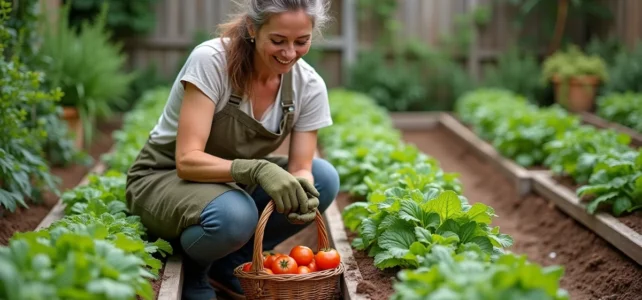
Two people, a garden, and the desire to fill the plate all year round without going to the supermarket. Before marking out the first beds, one quickly encounters a question of surface area. Planning too small means running out of vegetables by September. Planning too large means exhausting oneself weeding rows that can no longer be maintained.
Soil, climate, and water: the three variables that change the size of the vegetable garden
A single figure is often cited as suitable everywhere. In practice, the usable area primarily depends on the soil and local climate. Clay soil in Brittany does not produce the same as sandy soil in Provence, even with the same surface area.
Further reading : What is LPD in hotels? Complete guide to full board
The most underestimated constraint is water. During heatwaves, the most water-hungry crops (tomatoes, zucchinis, beans) can require the equivalent of a watering can per square meter per day. On sandy soil, retention is even lower, and the frequency of watering increases. Without reliable access to water (harvesters, wells, mains), a large area becomes counterproductive: one ends up watering poorly everywhere instead of watering well on fewer beds.
Thick mulching (straw, hay, wood chips) significantly reduces evaporation and limits the time spent watering. On this point, you can find advice from the site Le Jardin de Gaïa detailing the sizing suitable for a couple.
Read also : Tips and Ideas for Easily Maintaining Your Garden Year-Round
Before setting a surface area, three concrete questions must be answered:
- What is the type of soil (clay, loam, sandy) and its usable depth before reaching rock or compacted layers?
- What is the average summer rainfall in the area, and do we have a sufficient water reserve to compensate for dry weeks?
- How many hours per week can we realistically dedicate to maintenance, including sowing, harvesting, and processing?
A deep and cool soil in a region with mild summers will produce more on a reduced area. Conversely, in a dry area with thin soil, one must either increase the surface area or accept to supplement from the market during the hottest months.
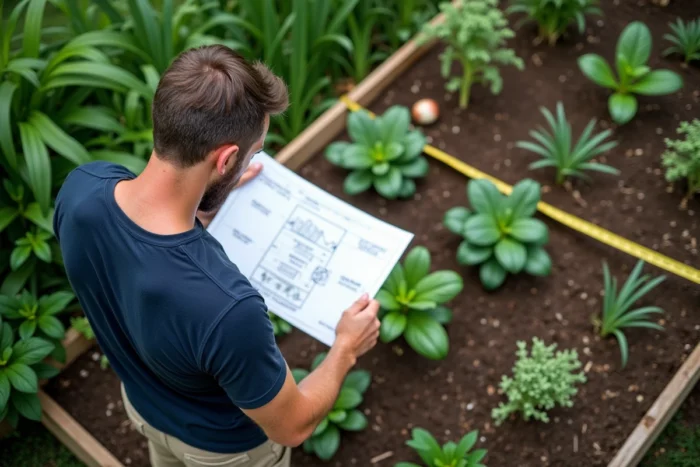
Intensive gardening: producing more on fewer square meters
Ecological intensification techniques change the game. Close block planting, rapid successions, and intercropping allow for multiple harvests from the same bed in a season.
The principle is simple: as soon as one crop is harvested, another is immediately planted. Radishes sown in March free up space for dwarf beans in June, followed by lamb’s lettuce in September. On a well-managed square meter, several kilos of vegetables can be obtained per year, whereas a traditional row spaced half a meter apart yields only one harvest.
Successful combinations for a small vegetable garden
Tomatoes and basil share the same heat requirements. Salads can be interspersed between tomato plants as long as the foliage does not shade them too much. Climbing beans use corn stakes, freeing up ground space.
Growing vertically (climbers on nets, trellises) frees up half of the ground area for low-growing crops. This is a direct lever on productivity per square meter, especially for cucumbers, pole beans, and peas.
Feedback varies on this point, but with these intensive methods, a well-managed vegetable garden for two people can operate on a significantly smaller area than what traditional guides suggest, provided regular monitoring is dedicated to it.
Vegetable garden area for 2 people: a realistic scale
Two very different objectives are distinguished. Supplementing meals with seasonal fresh vegetables requires much less area than aiming for complete food self-sufficiency over twelve months, including storage.
For a comfortable supplement (salads, tomatoes, zucchinis, herbs, a few rows of beans and carrots), a few dozen square meters of cultivated area is sufficient. One can eat from the garden from May to October without difficulty, and store a few jars for winter.
For advanced self-sufficiency including storage vegetables (potatoes, squashes, onions, beets, cabbages), dry legumes, and winter preserves, the cultivated area increases significantly. One must also add space for circulation between the beds, composting area, any frames or tunnels to extend the seasons, and tool storage.
Nourishing garden: beyond vegetables
If small fruit trees (currants, raspberries, strawberries) and a few edible perennials are included, food production increases without multiplying the work of sowing and planting each year. Edible perennials produce year after year without replanting, stabilizing part of the harvest.
A few rhubarb, chives, and sorrel plants take up little space and provide regularly. Trellised fruit trees along a wall or fence utilize often wasted vertical space.
Planning rotations and storage to last twelve months
Producing in summer is not a major problem. The real challenge for feeding two people all year round is the period from November to March. Without storage vegetables and preserves, the vegetable garden only covers six to seven months.
- Potatoes, squashes, and onions can be stored for several months in a cool, dry place without processing
- Dry beans, lentils, and chickpeas (if the climate permits) supplement the intake of plant proteins and can be stored for over a year
- Lacto-fermentation, drying, and canning allow for the preservation of tomatoes, zucchinis, and green beans harvested in full season
Planning from spring for crops intended for winter storage prevents ending up with a surplus of cherry tomatoes in August and nothing to eat in February. Rotating the beds (fruiting vegetables, leafy vegetables, root vegetables, green manures) maintains soil fertility and reduces disease pressure from one year to the next.
The ideal surface does not exist in absolute terms. It depends on the soil, climate, available water, and the time one is willing to spend. It is better to start with an area that one can manage, observe the actual yields in the first year, and then gradually expand. A poorly maintained large garden produces less than a small, dense garden that is tended to each week.