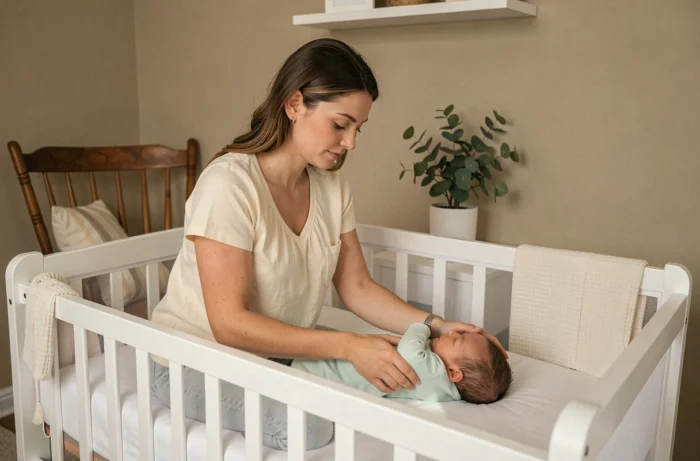
A newborn cannot distinguish between day and night. Their biological clock is simply not yet set, and their sleep cycles last much shorter than those of an adult. Preparing baby for sleep from the first months is not about imposing an artificial rhythm; it is about providing a stable framework for this clock to gradually start working.
Sleeping surface and inclined supports: what recent recommendations specify
Have you noticed that a baby easily falls asleep in a bouncer, swing, or car seat? This is common, but these supports are not designed for prolonged sleep. Recent recommendations emphasize one specific point: baby must sleep on a flat, firm, and non-inclined surface.
A firm mattress in a crib remains the safest configuration. If your child falls asleep in a carrying device or car seat during a trip, they should be transferred to an appropriate surface as soon as possible.
The crib needs nothing more than a fitted sheet. No blanket, no pillow, no bumper, no stuffed animal. Parents who want to prepare baby for sleep with Petits Bambins will find this same basic principle: a clutter-free sleeping space reduces risks and simplifies nights.
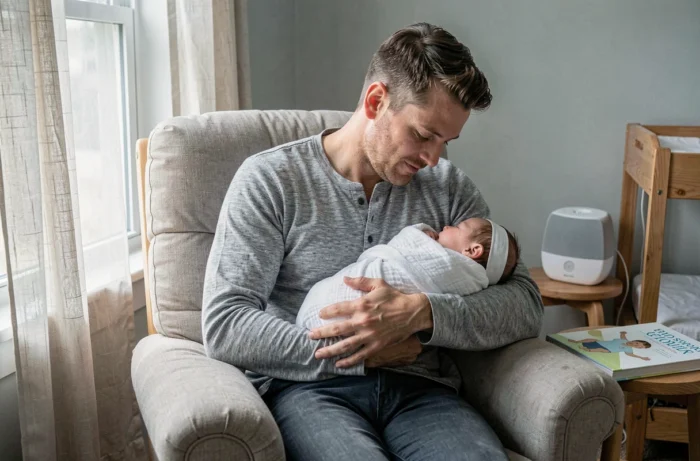
Room temperature and nighttime dressing
The temperature of the baby’s room plays a direct role in the quality of their sleep. A room that is too hot causes restlessness, frequent awakenings, and sweating. A room between 18 and 20 °C is suitable for most infants.
To check if your child is too hot or too cold, touch their neck or belly rather than their hands or feet, which often remain cool even when the rest of the body is at a good temperature.
Adapting sleepwear according to the season
The choice of sleepwear depends on the ambient temperature. A sleeping bag is a better alternative to a blanket, which can slip over the baby’s face during the night. The thickness of the sleeping bag adapts to the season: light in summer, thicker in winter.
- Below 18 °C: long-sleeved bodysuit, pajamas, and thick sleeping bag.
- Between 18 and 20 °C: bodysuit, light pajamas, and medium-thickness sleeping bag.
- Above 22 °C: bodysuit only or bodysuit and light sleeping bag, depending on the baby’s comfort level.
Watch for signs: a baby who sweats at the neck is wearing too many layers of clothing. Removing a layer is better than adding one just in case.
Room sharing without bed sharing: the distinction that matters
Many parents associate the term “co-sleeping” with sleeping in the same bed as their baby. In reality, recommendations clearly distinguish between two very different practices.
Room sharing for at least six months is recommended, as it facilitates nighttime feedings, reassures the baby, and allows parents to respond quickly. Bed sharing, on the other hand, increases certain risks, especially when compounded by aggravating factors: tobacco, alcohol, sedative use, extreme fatigue, or a baby born prematurely or with a low birth weight.
In practical terms, this means placing the baby’s crib close to the parents’ bed, in the same room, but with a separate sleeping space. Co-sleeping cribs with an open side for the parent exist for this purpose: they allow for proximity while maintaining a distinct sleeping surface.
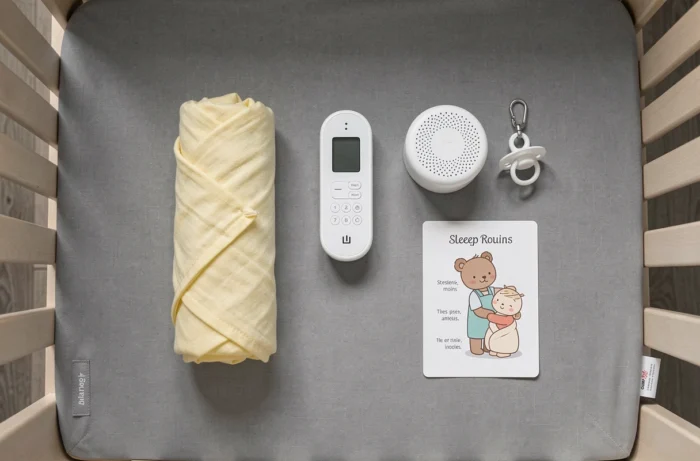
Infant sleep patterns: what is normal and what is not
A newborn sleeps in short periods, often two to four hours, spread throughout the day and night. They do not “sleep through the night” for several months, and that is normal.
By around three months, some babies begin to extend their nighttime sleep periods. Others will take longer. This variability is related to the maturation of the nervous system, not to a lack of routine or education.
Helping baby distinguish between day and night
This process occurs naturally, but a few actions can speed it up:
- During the day, let natural light in and maintain a normal noise level in the house.
- In the evening, gradually lower the brightness and reduce stimulation (play, screens, noise).
- During nighttime awakenings, keep the lighting dim and speak little, so the baby understands that night is not a time for activity.
- A short bedtime ritual repeated each evening (change, sleeping bag, lullaby or soft words) helps the baby anticipate sleep time.
This ritual does not need to be long or elaborate. Regularity matters more than the duration or complexity of the ritual. Two or three identical actions, done in the same order each evening, are enough to create a clear signal.
White noise and sound environment
White noise (a continuous, monotonous sound) can help some infants fall asleep, as it mimics the sound environment in utero. It is not suitable for all babies. If your child falls asleep just fine without it, there is no need to introduce it.
On the other hand, complete silence is not necessary. A baby used to sleeping in absolute quiet may wake up at the slightest noise from daily life. A moderate and consistent background sound promotes more stable sleep.
An infant’s sleep evolves quickly. What works at one month may not work at four months. Rather than searching for the perfect method, observe your baby: a child who wakes up in a good mood and remains alert during their awake phases is likely getting enough sleep, even if their schedule does not match what you had imagined.