
Fitting a sidecar to a motorcycle is not just about bolting an accessory onto a designated support. The operation alters the vehicle’s geometry, redistributes the masses, and changes the dynamic behavior of the whole. Before any installation, the question of compatibility between the motorcycle frame, the type of sidecar, and the fixation system determines the safety and longevity of the setup.
Side Loads on the Frame: What the Sidecar Imposes on the Motorcycle
A solo motorcycle absorbs vertical and longitudinal forces. The sidecar adds a permanent lateral component, which stresses the frame in an axis for which it was not originally designed.
Related reading : Everything You Need to Know About ATEX Compliance: Obligations, Levels, and Regulations Explained
This stress concentrates on the anchor points between the chassis and the sidecar. If the motorcycle frame is a tubular steel lattice, the forces distribute better than on a perimeter aluminum frame, which is stiffer locally but less tolerant to repeated transverse forces. In some cases, welded or bolted reinforcements on the frame are necessary even before installing the first support.
Field reports confirm that the fork and braking system must be evaluated at the same time as the frame. The fork absorbs an additional torque due to the asymmetry of the attachment, and the front braking, which works more in a straight line than solo, must be able to handle the combined weight of the motorcycle-sidecar-passenger. Understanding the fixation and compatibility of a motorcycle sidecar involves this overall analysis of the chassis, steering, and braking as an inseparable whole.
You may also like : Everything You Need to Know About Retail and Resell: How They Work and Their Impact on the Market
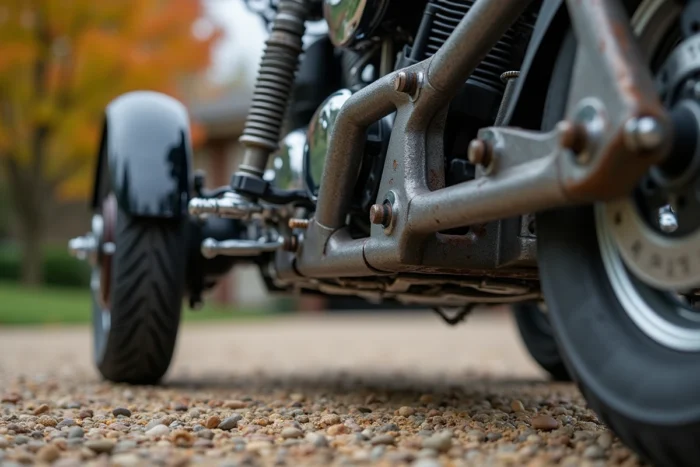
Sidecar Fixation Points: Triangulation and Alignment
The sidecar connects to the motorcycle through three or four fixation points, distributed between the front and rear of the frame. This arrangement forms a mechanical triangulation that must withstand accelerations, braking, and turns without play or deformation.
Each anchor point supports a different type of force:
- The front fixings take on the traction forces and part of the steering torque. They are often bolted to the frame tubes or engine plates.
- The rear fixings absorb the vertical load of the sidecar and resist pitching movements during braking.
- The intermediate connecting arms stabilize the whole laterally and prevent the sidecar from pivoting around the motorcycle’s longitudinal axis.
The final alignment between the motorcycle and the sidecar is adjusted by two parameters: toe-in (horizontal angle between the sidecar axis and the motorcycle axis) and camber (vertical tilt of the sidecar wheel). These adjustments depend on the motorcycle model, the weight of the sidecar, and the intended use. Insufficient toe-in pulls the motorcycle towards the sidecar during acceleration, while excessive toe-in pushes it away.
Limits of Universal Fixation Kits
So-called universal kits provide plates and bars that can be adapted to several motorcycle models. In practice, the adaptation remains approximate. Installation testimonials show that alignment, camber, and toe-in often need to be adjusted on a case-by-case basis depending on the exact geometry of the frame and the width of the sidecar.
A universal kit serves as a starting point, not a turnkey solution. Allowing time for adjustments, additional spacers, and sometimes specific drilling is part of the actual installation.
Motorcycle and Sidecar Compatibility: Vintage Bikes vs. Modern Models
Vintage motorcycles, with their simple tubular frames and more open steering geometry, generally accept the addition of a sidecar better. The fixation points are more accessible, and the moderate rigidity of the chassis absorbs part of the lateral stresses.
Modern motorcycles pose different problems. Aluminum frames or monocoque structures offer few flat surfaces for bolting supports. Onboard electronics (ABS, traction control, electronic suspension) can also react unpredictably to the asymmetry of the attachment. On some recent models, deactivating or recalibrating the stability electronics becomes a prerequisite for installation.

The weight of the motorcycle also comes into play. A heavy touring motorcycle offers better base stability, but its suspensions and brakes are already working close to their maximum load when solo. Adding a sidecar and a passenger can exceed the limits set by the manufacturer, which necessitates reinforcing the fork springs and sometimes replacing the rear shock absorber.
Homologation and Sidecar Regulations in France
Regulatory verification precedes the purchase of the sidecar, not the other way around. In France, a motorcycle-sidecar attachment must undergo a single approval (RTI) with the DREAL if the motorcycle manufacturer did not foresee this configuration. This procedure checks the mechanical compliance of the whole and conditions the update of the registration document.
Without this process, the attachment operates illegally and is not covered by insurance in case of an accident. The procedure generally involves presenting the assembled vehicle, checking the fixation points, and verifying the braking system.
- Check with the local DREAL for the required documents before starting the installation.
- Keep the invoices for the fixation kit and any modifications to the frame or suspension.
- Plan for the update of the registration document with the mention of the sidecar, which changes the vehicle category.
Installing a sidecar transforms a motorcycle into a three-wheeled vehicle whose dynamics, load, and regulatory framework have little in common with the original machine. Every step, from choosing the anchor points to adjusting the toe-in, affects the road handling and safety of the attachment over time.