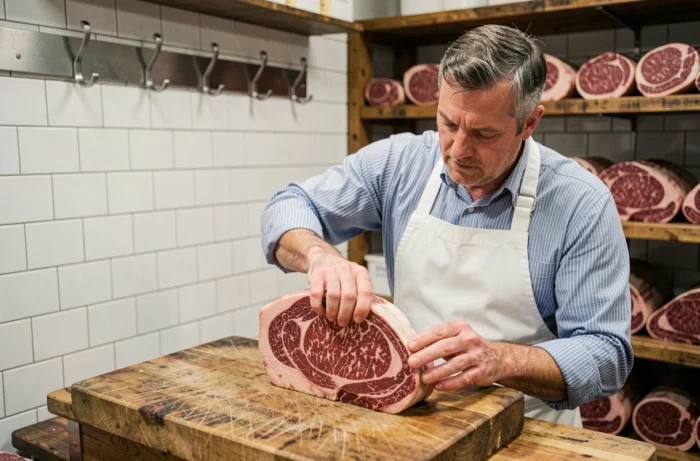
USDA Choice and Angus refer to two distinct realities of American beef. The former is a quality grade assigned by the United States Department of Agriculture based on the level of marbling in the meat. The latter refers to a cattle breed, the Black Angus, whose genetics promote abundant intramuscular fat. Comparing these two terms is akin to measuring a grading system against genetic heritage, two axes that intersect without merging.
Marbling and USDA Grade: What the American Classification Really Measures
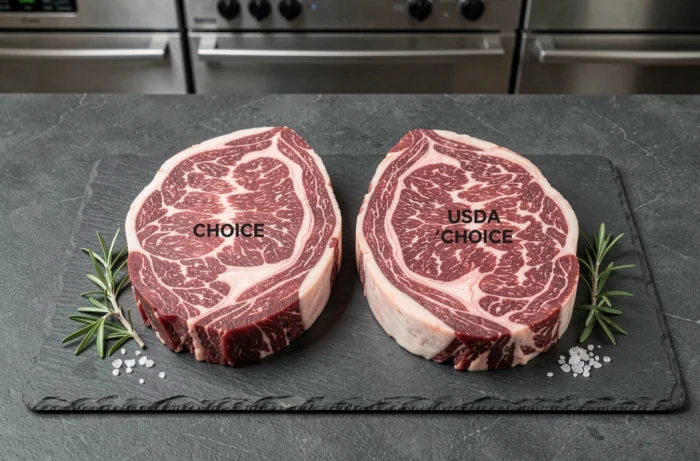
The USDA classification is based on one main criterion: the density of visible intramuscular fat between the 12th and 13th rib of the cattle. The Choice grade corresponds to marbling ranging from Small to Moderate, which is about 4 to 8% intramuscular fat. Above this, the Prime grade requires a Slightly Abundant marbling or more, with a minimum of about 8%.
This system does not take into account the breed, farming method, or diet. A grain-fed Hereford can achieve the same Choice grade as a grass-fed Black Angus. The classification is exclusively based on what the inspector observes on the carcass.
Understanding the differences between USDA Choice and Angus first requires admitting that these two terms do not operate on the same level: one is a post-slaughter quality verdict, while the other is a genetic legacy that influences the likelihood of reaching that verdict.
Significant data: nearly 86-87% of American carcasses now achieve the Choice grade or higher. This figure was lower a few years ago, and the Select grade now falls below 10%. The Choice grade, once a hallmark of distinctive quality, has become the norm in the American market.
Certified Angus Beef: A Program that Filters Within the Choice Grade
The term “Angus” on a label does not guarantee anything specific by itself. Any cattle exhibiting a predominantly Angus phenotype (black coat, characteristic morphology) can be marketed under the Angus label without any special certification.
The Certified Angus Beef (CAB) program changes the game. It imposes stricter criteria than the simple Choice grade:
- The marbling must reach at least the “modest” level, which corresponds to the upper part of the Choice grade only. Choice carcasses with “small” marbling (the lower end of the grade) are excluded.
- The texture of the fat matters: marbling deemed too coarse is rejected, even if the fat quantity is sufficient.
- The animal must exhibit a predominant Angus phenotype, visually verified on the carcass.
A steak labeled Certified Angus Beef is therefore consistently at the upper end of the Choice spectrum or in Prime. In contrast, a steak simply labeled “Angus” without certification could very well be at the lower end of the Choice grade, or even in Select.
The Difference Between Generic Angus and Certified Angus
This distinction is the blind spot for most consumers. The word “Angus” alone on the packaging implies no marbling control. It indicates a breed, not a quality. Only the Certified Angus Beef logo, with its documented selection criteria, adds a measurable layer of guarantee above the USDA grade.
Comparison Table: USDA Choice, Generic Angus, and Certified Angus Beef
| Criterion | USDA Choice | Generic Angus | Certified Angus Beef |
|---|---|---|---|
| Nature | Federal quality grade | Cattle breed | Certified brand program |
| Required Marbling | Small to Moderate | No minimum imposed | Modest or higher (top of Choice minimum) |
| Specific Breed | No | Angus phenotype | Predominant Angus phenotype |
| Fat Texture Control | No | No | Yes (coarse fat rejected) |
| Price Positioning | Mid-range | Variable | Above standard Choice |
This table shows that Certified Angus Beef combines breed and grade, whereas USDA Choice and Angus operate independently. A piece can be Angus without being Choice, or Choice without being Angus.

How to Read American Beef Labels in Practice
In the market, several combinations coexist and create confusion. A steak may display “USDA Choice Black Angus”: this means it comes from an Angus phenotype cattle and has achieved the Choice grade during inspection. The two mentions overlap without replacing each other.
A piece labeled simply “Angus” without USDA grade mention provides no reliable information about marbling. The absence of USDA grade on the label should raise a red flag, as it leaves the consumer without an objective benchmark for tenderness.
Conversely, a piece labeled “USDA Choice” without breed mention can come from any cattle cross. The taste quality then depends on the lot and diet, not on an identified genetic heritage.
Three Guidelines for Choosing in the Aisle
- Check for the presence of the USDA grade (Prime, Choice, Select): it is the only federal indicator of marbling.
- Distinguish generic “Angus” from “Certified Angus Beef”: only the latter imposes a minimal marbling requirement above the bottom of Choice.
- Cross-reference the two pieces of information: a Certified Angus Beef steak at the Choice grade offers a more consistent level of marbling than a standard Choice.
With the Choice grade now representing the vast majority of American beef, the mention alone is no longer sufficient to distinguish a superior quality piece. It is the combination with a certified program like CAB, or the transition to the Prime grade, that creates a real difference in marbling and tenderness that is perceptible in the mouth. The grade alone has become a floor, not a ceiling.