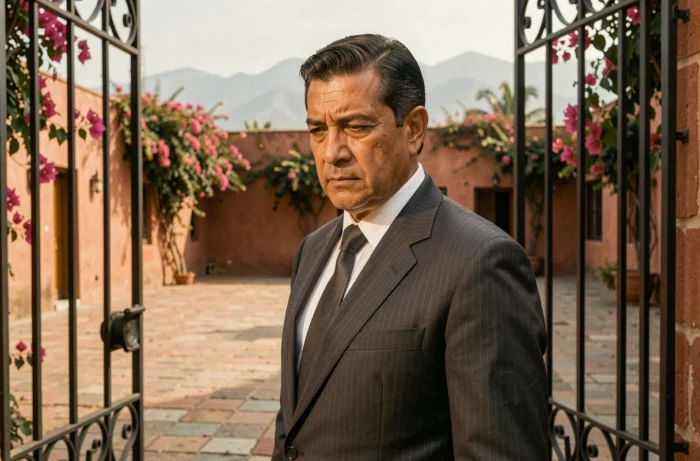
Miguel Ángel Félix Gallardo was born in 1946 in Culiacán, in the state of Sinaloa, the historical cradle of Mexican drug trafficking. A former police officer turned bodyguard for a local governor, he built the first centralized drug trafficking network on a national scale during the 1980s, before being arrested in 1989. His journey is not just an individual criminal trajectory: he laid the foundations for an organizational model that Mexican cartels still replicate today.
From Sinaloa to Guadalajara: how repression created a cartel
In the mid-1970s, Operation Condor, launched jointly by Mexico and the United States, aimed to eradicate marijuana and poppy cultivation in Sinaloa. Soldiers burned plantations, displaced entire communities, and used violence against farmers. The result was paradoxical.
Rather than destroying trafficking, this campaign pushed traffickers from Sinaloa to migrate to Guadalajara, a less monitored city with more developed logistical infrastructures. Félix Gallardo seized this opportunity to unite scattered operators into a single structure. His time in the police, followed by his role as an intermediary and collector of bribes for the governor of Sinaloa, had given him an intimate knowledge of institutional workings.
It was in this context that the Guadalajara cartel was formed, considered the quintessential drug lord in Mexico, an organization that transformed a craft trade into a transnational industry.
The Félix Gallardo model: centralization, corruption, and diversification
What distinguishes Félix Gallardo from the traffickers who preceded him is the construction of a organizational system modeled on a business. He did not just transport marijuana or cocaine: he controlled the routes, negotiated with Colombian producers, and redistributed territories among lieutenants.
Three pillars structured his empire:
- Centralization of transit corridors: all major routes between the Colombian border and entry points into the United States were under his control or that of his direct associates.
- Systematic political infiltration: Félix Gallardo maintained relationships with political officials, police, and military personnel at all levels, ensuring near-total impunity for nearly a decade.
- Economic diversification: the profits from trafficking were reinvested in legitimate businesses, real estate, and shell companies, making financial flows difficult to trace.
This model worked as long as Félix Gallardo maintained the balance between the different factions. He arbitrated conflicts, set quotas, and ensured that violence remained contained, a necessary condition to avoid attracting the attention of U.S. authorities.
The assassination of Kiki Camarena and the break with Washington
In 1985, DEA agent Enrique “Kiki” Camarena was kidnapped, tortured, and murdered in Guadalajara. This event marked an irreversible turning point. The United States, until then relatively tolerant of Mexican corruption in a Cold War context, exerted unprecedented diplomatic and judicial pressure on the Mexican government.
The Camarena case demonstrated that the political protection enjoyed by the cartel had geopolitical limits. As long as trafficking did not directly affect U.S. federal agents, the system held. The kidnapping and murder of a DEA agent crossed a red line that neither corruption nor political alliances could erase.
Field reports diverge on the degree of Félix Gallardo’s direct involvement in this assassination. He himself has always denied ordering the operation. Some analysts believe that lieutenants like Rafael Caro Quintero acted autonomously, while others argue that an act of such gravity could not occur without the cartel leader’s approval.
Arrest in 1989 and fragmentation of the Guadalajara cartel
Félix Gallardo was arrested in April 1989 in Guadalajara. According to several sources, he attempted in the months leading up to his arrest to organize an orderly transfer of power, distributing territories among his main lieutenants. This planned succession attempt failed.
The fragmentation that followed gave rise to the organizations that still dominate the Mexican criminal landscape: the Sinaloa cartel, the Tijuana cartel (Arellano Félix family), and the Juárez cartel (Amado Carrillo Fuentes). Each current cartel directly descends from the structure built by Félix Gallardo.
In contrast, violence exploded after this division. The centralized system maintained a certain order. Without an arbiter, territorial wars became the norm, a dynamic that has never reversed since.
Legal legacy and reclassification as anti-terrorism
Since 2025, the U.S. federal government has begun designating certain Mexican criminal organizations as terrorist entities. This change in legal framework paves the way for expanded financial sanctions, civil actions, and an extension of federal agency powers.
Civil lawsuits have been filed in the United States based on this anti-terrorism legislation against organizations considered direct heirs of the Guadalajara cartel. The assassination of Camarena, historically treated as a drug trafficking-related crime, is now mobilized in this new framework as an act that could fall under organized terrorism.
This reclassification is not only about the past. It aims to provide U.S. authorities with more powerful legal tools against contemporary cartels, establishing a direct lineage with the model founded by Félix Gallardo.
Félix Gallardo, now elderly and in poor health, is serving his sentence in Mexico. His case illustrates a lasting paradox of Mexican drug trafficking: the man who structured the first major cartel in the country also, unwittingly, created the conditions for the violence that has ravaged Mexico for three decades.