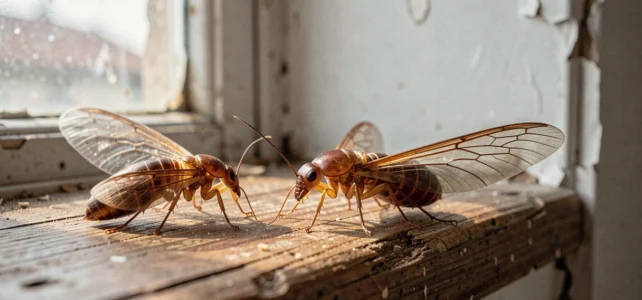
One spring evening, you turn on the living room light and a swarm of small winged insects swirls around the bulb. The first instinct is often to think of mosquitoes or flying ants. However, correctly identifying these visitors changes the course of events entirely, because if they are flying termites in the house, a colony is likely already active in your woodwork or nearby.
Regulations on termite treatments: what has changed recently
Several historical products have lost their market authorization, and the available treatment options are evolving rapidly.
Further reading : How to Successfully Calculate the Distance and Slope Percentage of a Ramp
The marketing authorization for Termidor SC (based on fipronil) has been withdrawn: its sale has been prohibited since March 2024, and its use since September 2024. Diflubenzuron, a common active substance in bait systems, has had its authorizations revoked as of January 31, 2025, with a grace period for use until January 26, 2026.
When a professional offers you a curative treatment, ask them which molecule they are using and whether its marketing authorization is still valid. A product withdrawn from the market cannot be applied legally, even if it remains in stock. These restrictions make it all the more useful to turn to certified professionals who keep up with the regulatory evolution of biocides.
You may also like : How to Navigate Effectively with a Clear and Structured Sitemap
Before proceeding to treatment, it is obviously necessary to confirm that they are indeed termites. This is the point where confusion with flying termites in the house and winged ants causes the most delays in addressing the issue.
Flying termite or winged ant: three reliable visual criteria
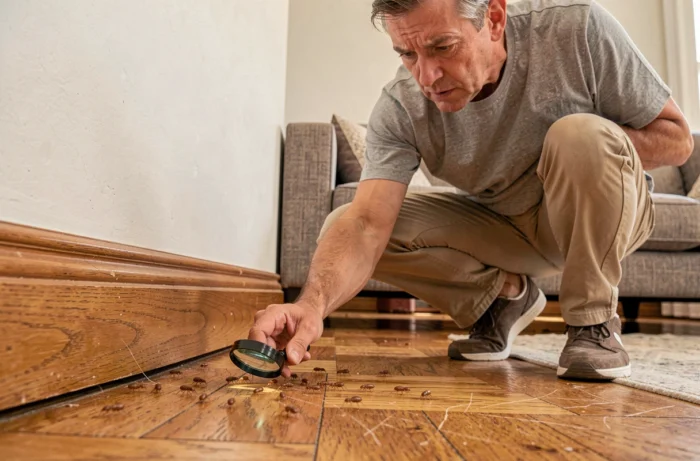
Have you captured a winged insect in your home? Place it on a white sheet and observe three specific areas. No magnifying glass is needed for the first two criteria.
The wings
A winged termite has four wings of equal length, which clearly extend beyond the abdomen. In the case of the flying ant, the front wings are longer than the hind wings. Another clue: termites shed their wings very quickly after flying. If you find small translucent wings piled up on a windowsill, it’s a strong signal.
The antennae
The antennae of the termite are straight, composed of small segments aligned like a string of beads. Those of the ant form a distinct elbow, shaped like an L.
The waist
The termite has a cylindrical body with no visible constriction between the thorax and abdomen. The ant, on the other hand, has a very slender waist, a kind of “pinching” between the two parts of the body. This criterion can even be seen on an insect just a few millimeters long.
- Identical and easily detachable wings: termite. Wings of different sizes: ant.
- Straight bead-like antennae: termite. Elbowed L-shaped antennae: ant.
- Cylindrical body without pinching: termite. Marked waist between thorax and abdomen: ant.
Signs of infestation in woodwork and structures
Swarming (the nuptial flight of termites) lasts only a few hours. Even if you haven’t seen insects flying, other signs betray an established colony.
Tap your baseboards, door frames, and exposed beams with the handle of a screwdriver. An infested wood sounds hollow and gives easily under light pressure. Termites consume the wood from the inside, following the soft fibers, which leaves an apparently intact outer surface.
Small mud tubes on walls or foundations are another marker. These tubes, the width of a pencil, allow workers to move between the ground and their food source without exposing themselves to light or dry air. If you break one and it is rebuilt within a few days, the colony is active.
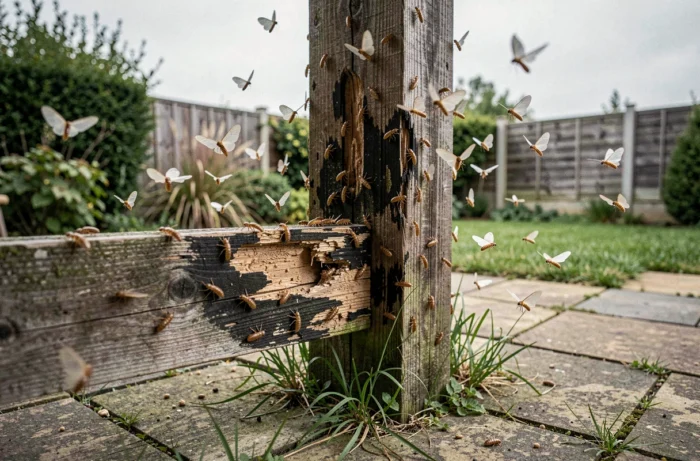
Small piles of translucent wings at the foot of windows or near light sources confirm that a swarming has occurred indoors. This means that the mother colony is mature enough to produce reproductives, which implies an established presence for several years.
Termite diagnosis: why a visual inspection is not enough
You can spot signs, but only a diagnosis conducted by a certified professional can measure the actual extent of the infestation. This diagnosis complies with the NF P03-201 standard and involves a methodical examination of the accessible structures of the dwelling.
A simple glance does not detect internal galleries or underground passages. The diagnostician uses specific tools (punch, moisture detector, sometimes thermal camera) to locate the attacked areas. The diagnosis is mandatory before any sale in municipalities classified as infestation zones by prefectural order, and more than fifty French departments are concerned.
The validity of the termite diagnosis is time-limited. If you are purchasing a property, check that the document is not expired. And if you are a homeowner in a risk area, regular checks (every few years) prevent discovering costly structural damage too late.
Acting against a colony of termites: concrete steps
Calling on a certified professional is the only truly effective way. Over-the-counter insecticides do not reach the heart of a colony, which can be several meters underground.
The two main families of curative treatment are chemical barriers (injection of product into the soil around the foundations) and bait traps. The traps work by ingestion of a growth regulator that the workers bring back to the colony. The process takes several months, but it aims for the complete elimination of the nest.
Given the recent withdrawals of molecules, always check that the proposed product has a valid marketing authorization. A serious professional will provide you with this information without difficulty.
Reducing humidity around the foundations (ventilating crawl spaces, repairing leaks) and eliminating direct wood-to-soil contact (storing logs against the facade, fence posts driven into the ground) are complementary measures that slow the progression of an infestation without resolving it alone.
Early detection remains the determining factor. Spotting a swarm in May, followed by a diagnosis shortly after, significantly limits the extent of necessary work. Waiting a year turns a localized treatment into a structural project.