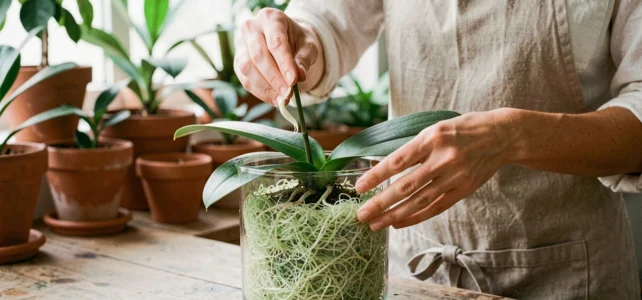
Sphagnum used as a sole substrate in semi-hydroponics presents a structural problem that most guides overlook: its water behavior changes radically depending on whether it is submerged in a permanent water reservoir or simply moistened by capillarity. Understanding this distinction is crucial for the survival of orchid roots in this type of setup.
Capillarity and saturation: the water behavior of sphagnum in a water reservoir
In traditional cultivation, sphagnum dries out between waterings. The wet-dry cycle promotes root aeration and limits anaerobic development. In semi-hydroponics, the water reservoir maintains a permanently saturated zone at the bottom of the pot. Sphagnum, through capillarity, draws this water well above the level of the reservoir.
You may also like : How to Reduce Age d'Or Services Rates in 2026 for Your Parents?
The result: the substrate column remains moist throughout its height, without a dry gradient at the surface. For a Phalaenopsis, whose epiphytic roots poorly tolerate prolonged asphyxiation, this constant saturation poses a direct risk of rot. We observe that the problem worsens in opaque pots where lateral evaporation is nearly nonexistent.
The absorption capacity of sphagnum, often presented as an asset, becomes a compounding factor here. The longer and denser the fiber, the more effective the capillary rise, and the larger the saturated zone expands. Choosing sphagnum for orchids in semi-hydro requires mastering this mechanism, or else one risks replicating the conditions of a pot without drainage.
Read also : The best strategies to succeed in your digital marketing in 2024
Hybrid setup of LECA and sphagnum: stabilizing the substrate without drowning the roots
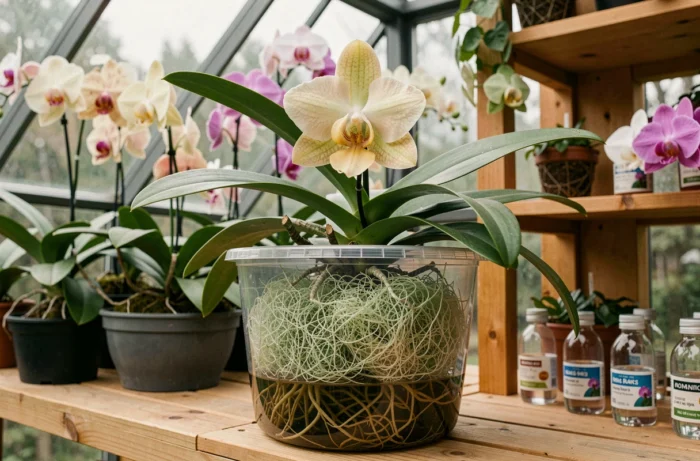
An approach gaining traction in grower communities involves combining LECA balls and sphagnum in the same pot with a water reservoir. The principle: the expanded clay balls occupy the bottom and ensure drainage, while a layer of sphagnum on top stabilizes the roots and maintains local humidity.
Sphagnum prevents LECA balls from floating when filling the reservoir, a common issue in pure semi-hydro. Feedback from growers on sensitive plants like Alocasia shows good recovery after stress, provided that the water is renewed weekly and a stable level is maintained in the reservoir.
For orchids, this hybrid setup offers a specific advantage: it creates two distinct zones in the pot.
- The lower zone (LECA) remains aerated thanks to the porous structure of the balls, even when in contact with the water reservoir. The roots that descend find oxygen there.
- The upper zone (sphagnum) retains ambient moisture without direct contact with stagnant water. The aerial roots and the collar remain protected from saturation.
- The interface between the two layers acts as a buffer: sphagnum absorbs just enough water by capillarity to stay fresh, without reaching the point of complete saturation.
We recommend not mixing the two materials. Layering the materials while maintaining a clear separation yields better results than creating a homogeneous mix where sphagnum clogs the gaps between the balls.
Degradation and renewal: the constraint that semi-hydro amplifies
In a traditional pot, sphagnum degrades slowly. In semi-hydroponics, the constant contact with water accelerates decomposition. The fiber compacts, loses its alveolar structure, and forms a dense mass that retains even more water while reducing gas exchanges.
The warning sign is visual: when sphagnum changes from a fibrous texture to a pasty consistency, the substrate has lost its draining properties. At this stage, orchid roots develop characteristic brown necrosis indicative of root anoxia.
In a hybrid setup, only the upper layer of sphagnum needs to be replaced. This is a practical advantage compared to an all-sphagnum substrate, where repotting involves handling the entire root system. Renewing the sphagnum at the first signs of compaction avoids the critical phase where roots begin to rot without visible foliar symptoms.
Replacement frequency according to the setup
| Configuration | Renewal frequency | Triggering sign |
|---|---|---|
| Sphagnum alone in semi-hydro | Frequent | Pasty texture, sour smell |
| Hybrid LECA + sphagnum | Less frequent | Compaction of the upper layer |
| Sphagnum in traditional pot (reference) | Standard | Loss of volume, uniform dark coloration |
Orchids suited to sphagnum in semi-hydroponics: not all genera react the same
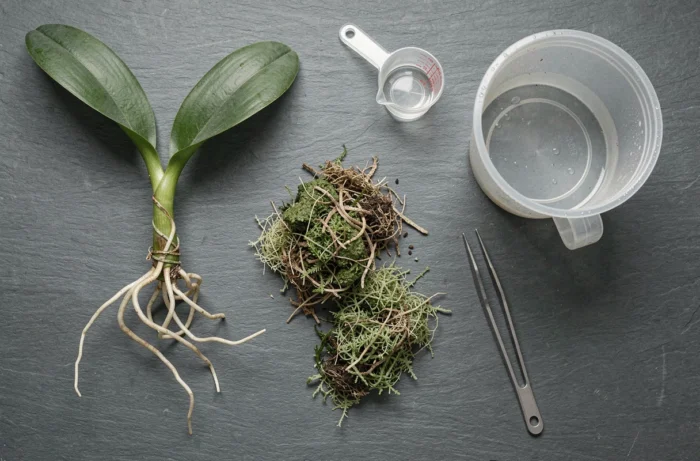
Phalaenopsis tolerate semi-hydro with sphagnum, but their margin for error is slim. A water level that is too high or sphagnum that is too compact is enough to cause root loss within a few weeks. Bulbophyllum, on the other hand, tolerate constant humidity better, as their fine roots adapt to saturated substrates.
Feedback from growers on Bulbophyllum in a semi-hydro environment confirms that sphagnum maintains the moist surface conditions that this genus requires. The risk of rot remains, but it is significantly reduced compared to Phalaenopsis or Cattleya, which require partial drying between waterings.
The choice of orchid genus thus determines the viability of the setup. Using sphagnum in semi-hydro for a mixed collection involves differentiating the configurations pot by pot, which partially negates the standardization advantage that semi-hydroponics is supposed to provide.
Sphagnum in semi-hydroponics is neither a miracle substrate nor a systematic error. It works in a hybrid setup with LECA, for genera that tolerate constant humidity, with rigorous monitoring of water levels and regular replacement of the fiber. Used alone in a water reservoir for a Phalaenopsis, it creates more problems than it solves.