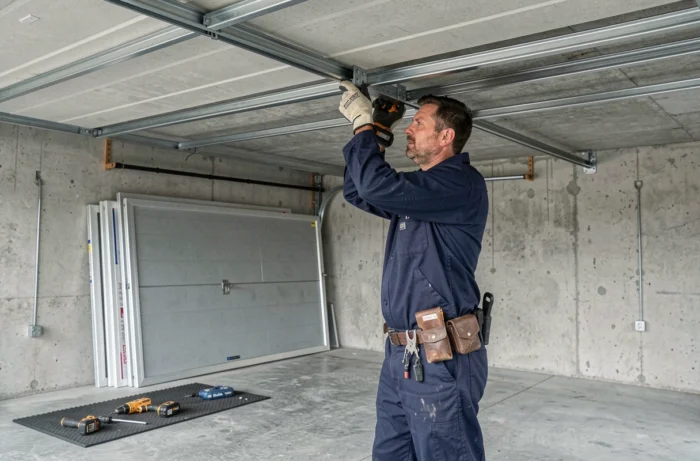
Installing a motorized sectional garage door requires balancing two types of requirements that are rarely presented together: those of the construction product (the door itself) and those of machine legislation (the motor). This dual compliance, framed notably by standard EN 13241 for the door and the Machinery Directive for the motorization, conditions the safety, warranty, and value of the installation.
Understanding this framework before touching the first guide rail avoids costly mistakes to correct later.
Double regulatory requirement: construction door and Machinery Directive
Before screwing in the rails and adjusting the springs, one point deserves attention: the sectional door falls under a declaration of performance as a construction product, while the motorization requires a separate CE declaration of conformity.
In practice, this means that the manufacturer must provide two distinct documents. The declaration of performance covers wind resistance, water tightness, and thermal performance of the door. The CE declaration of conformity for the motor certifies compliance with machine safety requirements, notably force limitation and obstacle detection.
During a installation and fitting of a motorized sectional garage door, checking for the presence of these two documents before starting the work protects against insurance refusal in case of a claim. A professional installer systematically archives them in the installation file.
Standard EN 12453 and safety of use
Standard EN 12453 sets the maximum force thresholds that a motorized door can exert during closing. This text mandates the presence of an anti-crushing device and obstacle detection, whether the motor is chain-driven, belt-driven, or rack-and-pinion.
The absence of compliance with this standard is not visible to the naked eye. It becomes apparent during an inspection or, more seriously, during an accident. Requesting an EN 12453 test report from the supplier is a simple reflex that eliminates most risks associated with motorization.
Door-motor compatibility: parameters to check before purchase
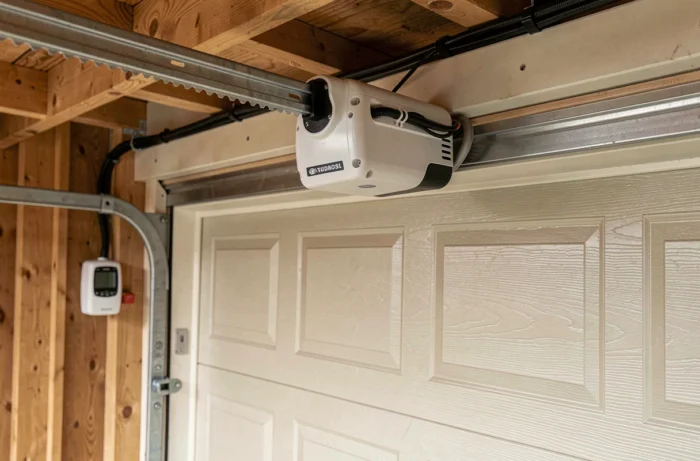
A recurring field report in 2026 concerns the actual compatibility between an existing door and a new motor. A powerful motor does not compensate for a mechanical imbalance of the door. The table below summarizes the parameters to cross-check before any investment.
| Parameter | What to check | Consequence if ignored |
|---|---|---|
| Weight of the door | Weigh the door or consult the manufacturer’s technical sheet | Undersized motor, premature wear of gears |
| Lintel drop height | Measure the space between the top of the opening and the ceiling | Motor rail impossible to fix, incompatible motorization |
| Type of springs | Torsion (above the opening) or tension (on the sides) | Poor choice of conversion kit, permanent imbalance |
| Condition of cables and rollers | Check for broken strands and wear on bearings | Stalling during the cycle, risk of door falling |
| Ceiling clearance | Measure the available depth for the horizontal rail | Door that does not open fully, loss of usable height |
The lintel drop height is the most often underestimated parameter. Insufficient drop prevents the motor support from being fixed and may require changing the type of motorization or even modifying the masonry.
Motorization by chain, belt, or rack-and-pinion
The choice between these three technologies depends on usage and environment.
- Chain motorization offers robustness suitable for heavy doors and intensive use but generates a noise level perceptible in adjacent rooms to the garage.
- Belt motorization significantly reduces operating noise, making it preferable when the garage adjoins a bedroom or living room.
- Rack-and-pinion motorization, where the motor moves directly on the rail, is suitable for configurations where ceiling space is limited but requires precise alignment of the rail.
For a standard residential garage sectional door, the belt represents the best compromise between silence and durability. The chain remains relevant for large doors or garages used for professional purposes.
Biannual preventive maintenance: what has changed in practice
The underlying trend in 2026 is the shift from annual maintenance to biannual checks of motorized doors. This evolution concerns both residential installations and industrial doors and is explained by feedback on avoidable breakdowns.
A biannual check targets four priority elements:
- The torsion or tension springs, whose tension gradually degrades and alters the balance of the door.
- The lifting cables, to be visually inspected for frayed strands or deformation at the anchoring point.
- The peripheral seals (bottom of the door, side seals), whose wear degrades the sealing and increases thermal losses.
- The obstacle detection system, to be tested by placing an object in the closing path to verify automatic reversal.
A fatigued torsion spring increases the load on the motor and reduces its lifespan. Identifying this wear during a biannual check costs much less than an early motor replacement.
Door balancing: the simple test
Unplug the motor, lift the door to mid-height, and release it. If it stays in place, the balance is correct. If it descends or rises, the springs need adjustment. This test takes less than a minute and is the best indicator of the overall mechanical condition of the door.
Installation by a professional or DIY: decision criteria
DIY installation is technically possible for an experienced handyman with a level, a percussion drill, and at least one person to help handle the panels. The installation time varies according to experience but generally exceeds a full day for a first installation.
However, the adjustment of torsion springs remains the most dangerous step in the process. These springs store considerable energy and can cause serious injuries if handled incorrectly. It is on this specific point that hiring a professional is most clearly justified, even if the rest of the installation is done independently.
The intervention of a qualified installer also guarantees compliance with documentation (CE declaration, EN 12453 report) and the validity of the manufacturer’s warranty, two elements that solo installation does not automatically cover.
The mechanical risk associated with the springs and the legal coverage provided by a certified installer weigh as much in the decision as the installation budget.