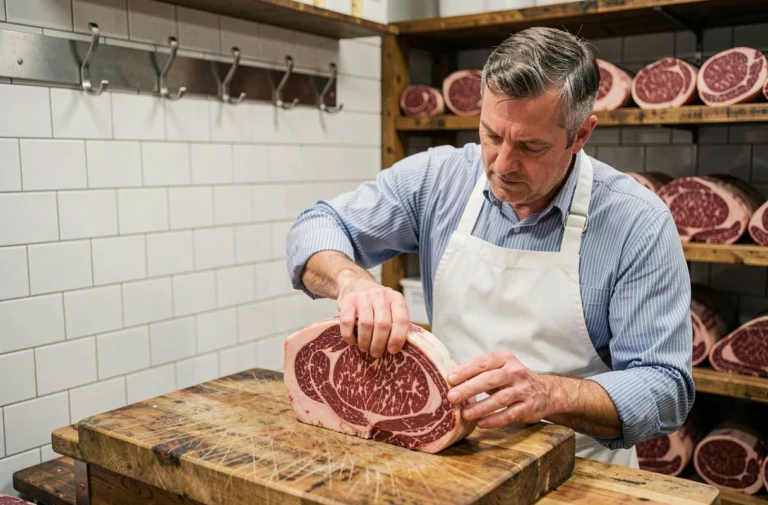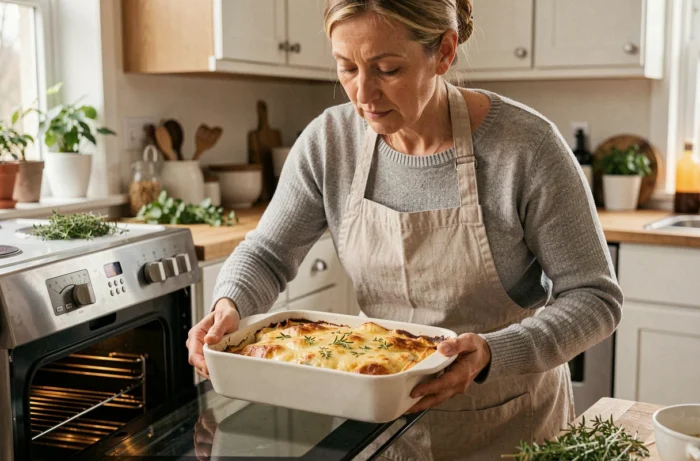
We take a gratin out of the oven and the crust is barely golden, or on the contrary, the bottom is burnt while the center remains lukewarm. In most cases, the problem comes from a poor thermostat setting, not the recipe. At 150 degrees, we are in a gentle cooking zone that requires a bit of method, but which opens the door to results that are difficult to achieve otherwise.
Difference between displayed temperature and actual temperature at 150 degrees
Before discussing recipes, a technical point often overlooked. Recently published calibration tutorials show that a domestic oven can have a notable difference between the displayed temperature and the actual temperature, particularly around 150 °C. In some models, the difference can reach several tens of degrees.
In practice, we set the oven to thermostat 5 thinking we are getting 150 °C, but the internal probe of the oven (when it exists) or an external control thermometer shows 135 or 170 °C. Feedback varies on this point depending on the age and brand of the oven, but the phenomenon is well documented enough to be taken seriously.
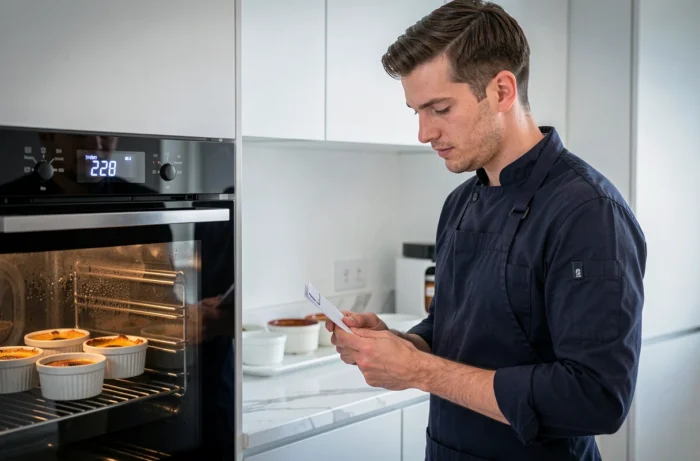
To know where we stand, the simplest method is to place an oven thermometer in the center of the rack, preheat for about twenty minutes, and compare. If the difference exceeds about fifteen degrees, we adjust the thermostat up or down or compensate by monitoring the cooking more closely.
When looking for which thermostat corresponds to 150 degrees, the standard answer is thermostat 5. The conversion rule is straightforward: multiply the thermostat number by 30 to get the temperature in degrees Celsius. Thermostat 5 indeed gives 5 x 30 = 150 °C. This rule works for any type of oven, whether electric, gas, or convection.
Thermostat 5 and convection: should you lower the temperature?
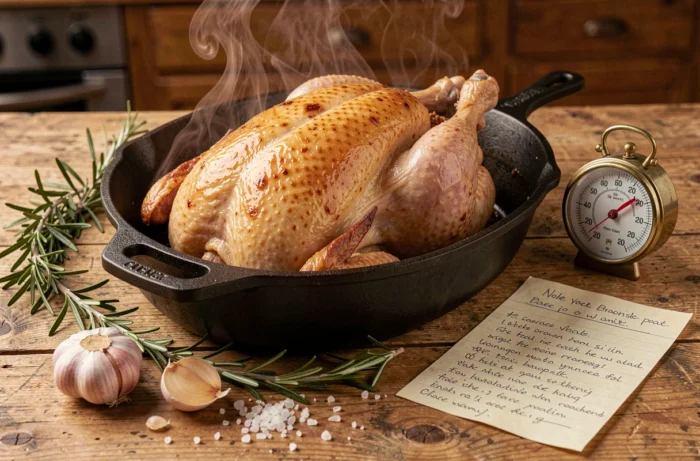
In convection mode, the air circulates around the dish and cooking becomes more efficient. Most manufacturers recommend reducing the temperature by 10 to 20 °C compared to natural convection. In other words, if a recipe indicates 150 °C in traditional mode, you can lower it to 130-140 °C in convection for an equivalent result.
In practice, we often stay on thermostat 5 but shorten the cooking time by a few minutes. The advantage of convection at this temperature is a more even cooking, especially when baking multiple dishes on different racks.
When to favor natural convection
Some delicate dishes (meringues, soufflés during rising, puff pastries at the beginning of cooking) do not handle the airflow of convection well. At 150 °C, natural convection allows time for the structure to form without surface drying. We keep convection for meat cuts and gratins, and revert to static mode for delicate pastries.
Dishes and recipes suitable for cooking in the oven at 150 °C
150 °C is a medium oven, ideal for long cooking and melting textures. Here are the categories of dishes that make the best use of this temperature.
- Braised and confit meats: a low-temperature pork roast, a confit lamb shoulder, or a slowly cooked duck take their time at 150 °C. The gentle heat melts connective tissues without drying out the meat. Generally, cooking time is longer than at 180 °C, but the tenderness result is incomparable.
- Delicate pastries: meringues, macarons during drying, travel cakes (fruit cake, dense pound cake) cook through without browning too quickly. You get a thin crust and a soft interior.
- Slow-roasted vegetables: whole beets wrapped in aluminum foil, confit garlic heads, semi-confit cherry tomatoes. At 150 °C, the sugars caramelize gently and the flavors concentrate.
- Reheating pastries: croissants or pains au chocolat from the day before regain their crispness in 5 to 7 minutes at 150 °C, in convection or traditional mode. Beyond that, they start to harden.
Slow cooking meat: practical guidelines
For a piece of meat to braise, we assume that cooking at 150 °C requires significantly more time than indicated for 180 or 200 °C. A lamb shoulder, for example, can stay in the oven for several hours at this temperature. We check the cooking with a fork: if the meat pulls away effortlessly, it’s ready.
The cooking liquid (wine, broth, tomato juice) plays a role as a thermal regulator. We always keep a bit of liquid at the bottom of the dish to prevent the piece from drying out, even at moderate temperature.
Thermostat and oven temperature correspondence table
To have the benchmarks at hand, here are the common equivalences, from thermostat 1 to thermostat 9.
| Thermostat | Temperature (°C) | Type of oven |
|---|---|---|
| 1 | 30 °C | Warm oven |
| 2 | 60 °C | Warm oven |
| 3 | 90 °C | Gentle oven |
| 4 | 120 °C | Gentle oven |
| 5 | 150 °C | Medium oven |
| 6 | 180 °C | Medium oven |
| 7 | 210 °C | Hot oven |
| 8 | 240 °C | Very hot oven |
| 9 | 270 °C | Very hot oven |
The formula remains the same in all cases: thermostat number multiplied by 30 equals the temperature in degrees Celsius. In case of doubt in front of an old oven without readable graduations, an oven thermometer costing a few euros resolves the issue.
Common mistakes at 150 °C in the oven
At this temperature, failures rarely come from an oven that is too hot. The classic trap is the opposite: not preheating long enough. An oven that displays 150 °C on the screen has not necessarily reached this temperature in the center of the cavity. Count on a good quarter of an hour of preheating before baking, especially on an older model.
Another common mistake: opening the door too often. At 150 °C, each opening significantly drops the temperature, and the oven takes time to recover. We limit ourselves to a check in the middle and at the end of cooking.
The choice of baking dish also matters. A clay or cast iron dish retains heat and releases it gradually, which is perfect for 150 °C. A thin metal pan transmits heat faster and can cause the bottom to overcook before the top is ready.
Thermostat 5 is nothing spectacular, but it is the most versatile temperature for those who are willing to give the oven time to do its job. A control thermometer, serious preheating, and the right convection mode are enough to transform this moderate heat into regular and controlled cooking.