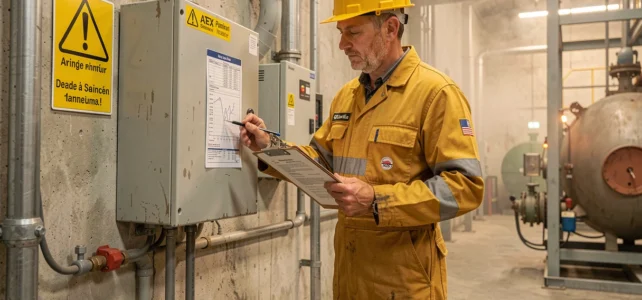
ATEX compliance is based on a regulatory framework that many industrial sites apply without mastering the details. Two distinct European directives, obligations that vary according to the role of the actor (manufacturer, importer, employer), and a zoning system whose classification logic conditions every equipment choice: these are the points we consider underutilized in most field approaches.
Periodic verification of ATEX equipment: three levels of examination to distinguish
The maintenance of devices installed in explosive zones is not limited to an annual visual inspection. Inspection practices now structure verification around three levels of examination: visual, close-up, and detailed. Each level involves a different degree of disassembly, tooling, and expertise.
See also : Everything You Need to Know About Sidecar Motorcycle Mounting and Compatibility Before Installation
The visual examination consists of spotting apparent defects without opening the enclosure. The close-up examination adds direct manipulation (tightening of the stuffing box, checking the seal play). The detailed examination requires complete opening of the device and measurement of parameters such as the air gap or insulation resistance.
We recommend basing the frequency on the risk assessment specific to each zone rather than on a fixed schedule. Equipment in zone 1 gas that is continuously used requires a much tighter frequency than a sensor in zone 22 dust in a ventilated room. To understand ATEX compliance and legislation in its operational implications, this gradation logic is the starting point.
You may also like : Everything You Need to Know About Retail and Resell: How They Work and Their Impact on the Market

Product directive and workplace directive: two ATEX scopes often confused
The directive 2014/34/EU concerns manufacturers and importers of devices and protection systems intended for explosive atmospheres. It imposes a conformity assessment procedure before market release, a readable CE/ATEX marking, and a EU declaration of conformity accompanied by technical documentation.
The directive 1999/92/EC addresses employers. It requires them to assess the explosion risk, classify the zones, draft the explosion protection document (EPD), and train exposed personnel. These two texts complement each other but do not replace one another.
Confusing these scopes leads to costly mistakes. An importer who places an ATEX-certified luminaire on the market without checking the technical documentation bears the same responsibility as a manufacturer. For employers, having compliant equipment does not exempt them from zoning or the EPD.
Specific obligations of importers
Recent guides emphasize a point that we regularly see neglected: the importer must verify, before any availability, the conformity of the assessment procedure, the presence of the CE/ATEX marking, the availability of the EU declaration of conformity, and the provision of safety instructions in the language of the member state. A failure in any of these elements is enough to render the market release non-compliant.
ATEX zoning for gases and dust: classification and associated equipment categories
The classification of zones is based on the likelihood of the presence of an explosive atmosphere. For gases and vapors, three zones exist:
- Zone 0: explosive atmosphere present continuously or for long periods. Only equipment of category 1G is allowed.
- Zone 1: explosive atmosphere likely to form during normal operation. Equipment of category 1G or 2G.
- Zone 2: explosive atmosphere unlikely and, if it occurs, of short duration. Equipment of category 1G, 2G, or 3G.
For dust, the logic is the same with zones 20, 21, and 22, associated respectively with categories 1D, 2D, and 3D. The suffix G designates gases, and D designates dust.
Reading the marking on a certified device
The ATEX marking of equipment includes a standardized sequence. It displays the hexagonal symbol Ex, the equipment group (I for mines, II for surface industries), the category (1, 2, or 3), and the type of protection (for example, “d” for flameproof enclosure, “e” for increased safety).
It also includes the temperature class and, where applicable, the gas group (IIA, IIB, IIC). An error in reading the category or temperature class is enough to render the installation non-compliant.
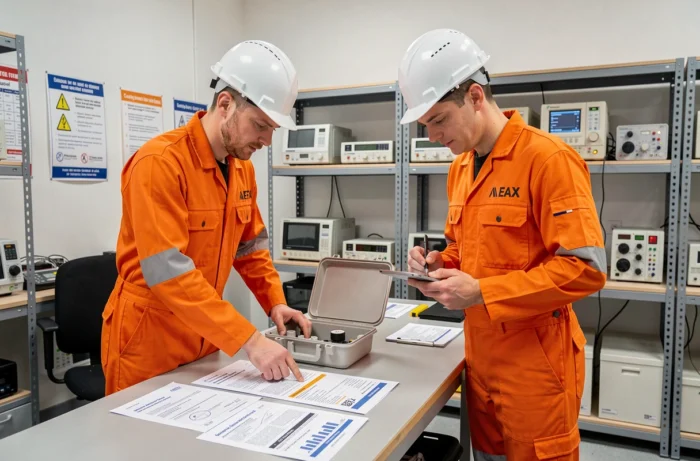
EPD and site technical file: what DREAL audits verify
The EPD is often perceived as a static administrative document. In practice, audit feedback shows that the competent authorities (DREAL, DRIEAT) expect a living file, updated with every process or layout change, and readily available during an inspection.
Beyond the EPD itself, the site technical file must include up-to-date zoning plans, safety data sheets for the substances handled, certificates for the installed equipment, and periodic verification reports. The absence of any one of these elements during a check exposes the operator to a formal notice.
We observe that the best-prepared sites centralize these documents in a unique repository, indexed by zone and equipment, with an alert system for renewal dates of verifications. This organization is not an excess of zeal: it precisely reflects what ATEX regulation expects from an employer responsible for a classified installation.
The ATEX framework does not reward theoretical compliance. It penalizes the gap between what is documented and what actually exists on the ground. A correct zoning associated with suitable equipment and a complete technical file remains the only combination that withstands an audit without reservation.